More autonomous vehicles will appear in Singapore in the next 2 years.
This is because Waymo has plans to introduce a fleet of fully autonomous ride-hailing services in Singapore in 2028. And yes, these vehicles will be fully electric too.
As the push toward technology to replace mundane, repetitive tasks grows, artificial intelligence (AI) will continue to expand and disrupt the economy.
And this week’s #PowerStocks pick belongs to the technology sector, with a heavy focus on AI.
But before I analyze this week’s stock pick, let’s review last week’s #PowerStocks pick: Advanced Micro Devices (AMD).
Review Of Last Week’s Pick Of The Week
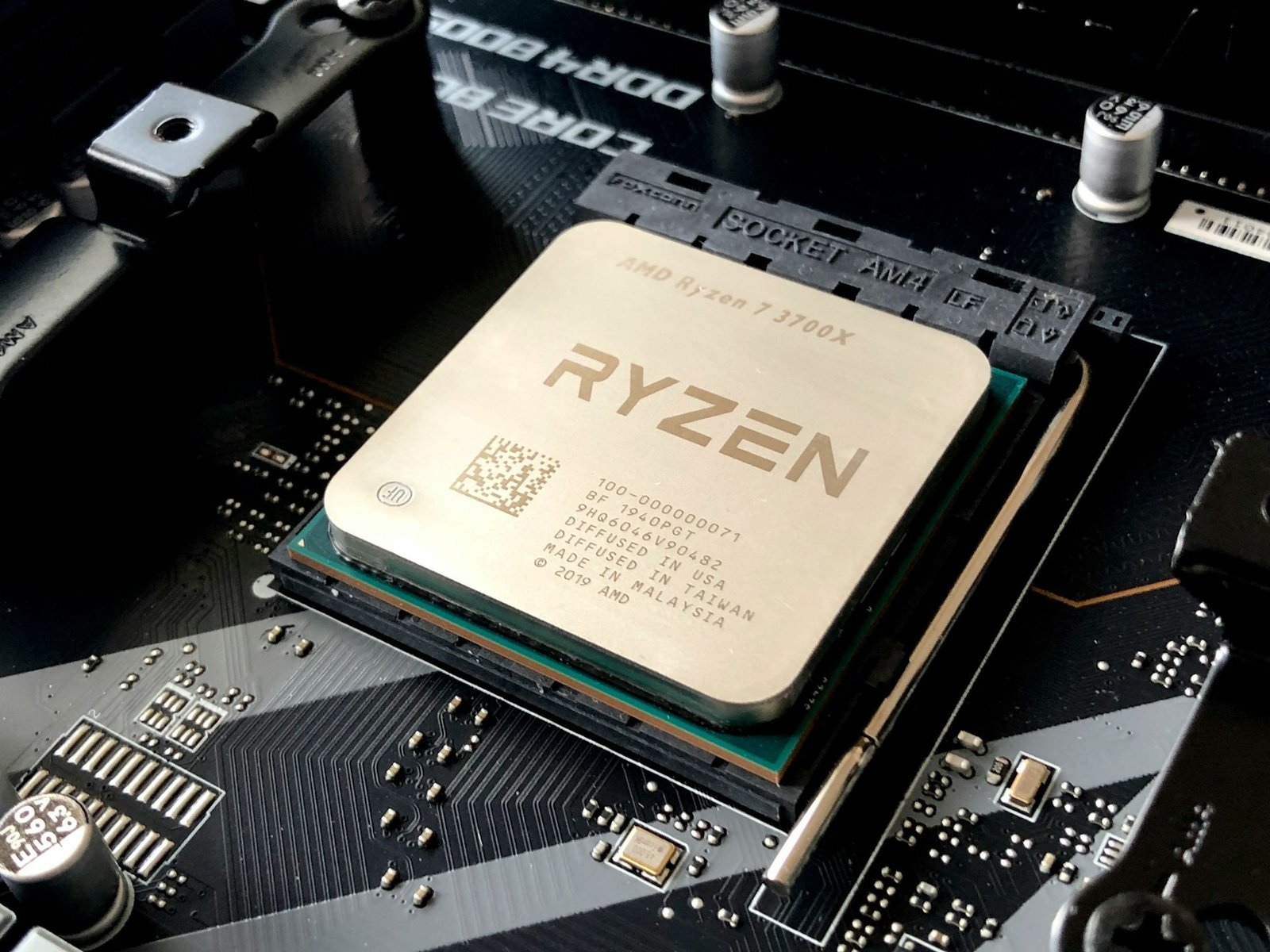
Advanced Micro Devices (AMD) was last week’s #PowerStocks pick.
It’s the world’s 7th-largest semiconductor company, with a market value of over $842b.
Despite its enormous market capitalization, its shares have been exploding higher continually.
After rising over 19% in a week, it began pulling back.
I foresaw this pullback was about to end, so I aimed to buy its shares on the breakout around $517.
Just a few days later, the pullback ended. Its shares soared hard, rising 5% in 2 days, almost reaching my 1st take-profit level.
Where do I plan to take profit at?
Head over to my Telegram Channel to find out!
Speaking of Telegram, my team and I will never ask you for your hard-earned money for “investments”.

I know and understand that the allure of high returns without effort is highly attractive. It breaks my heart when I hear of people falling for impersonation scams.
To protect you from scams, please note that my team and I WILL NEVER solicit for any investment.
A list of our official communication channels can be found here.
Why Is Swing Trading Intel (INTC) Worth It?

Source: intc.com
Intel (INTC) is a US technology company that designs, manufactures, and provides computing, data center, IOT, and memory solutions.
Its products and services are used across a wide range of industries, including retail, health care, and even automotive.
With a market capitalization of nearly $575b, Intel is the world’s 17th-largest technology company.
Unlike many large companies whose shares exhibit lethargic price movement, its shares are highly active, consistently surging.
After surging 17.8% in a week, a pullback could emerge soon.
When that happens, it could be the perfect moment to buy its shares and capture its next explosive upmove.
What’s my game plan?
Where’s a favorable price area to buy its shares at?
Continue reading to get the details.
Performance Of US Stock Market vs Intel (INTC)
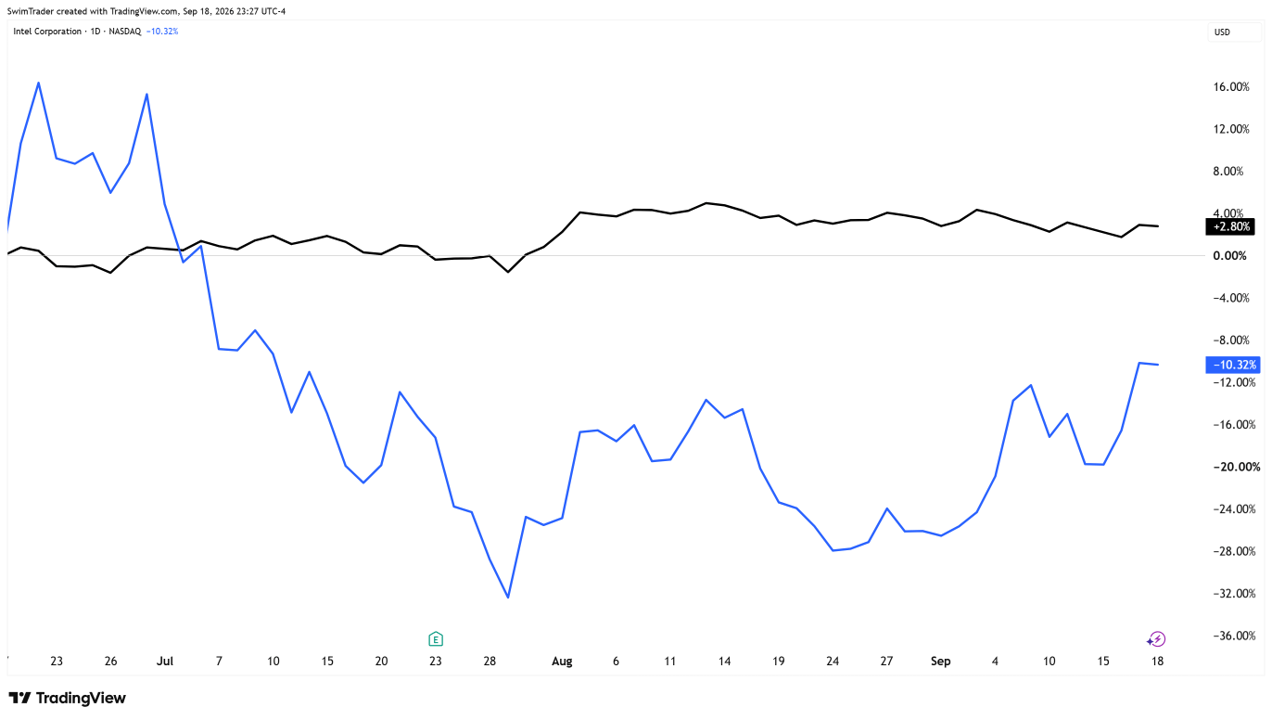
The very 1st thing I want to know is the trend of Intel’s shares.
Knowing the trend of its shares allows me to determine whether I’d look for a buying or shorting opportunity because following its price trend will sharply increase my chances of profitability.
Looking at the chart above, its shares were sliding hard till August 2026. Thereafter, Intel’s shares began rising. Hence, I’d like to find an opportunity to buy its shares.
What’s next?
I’ll compare the performance of its shares against the S&P 500.
Why?
I want my hard-earned money to work hard for me. A stronger-performing stock is likely to continue bringing a larger-than-market return. So, I’ll have a look at the comparison chart above again.
Although the performance of Intel’s shares over the past 3 months has fared poorer than the S&P 500, I’m heartened that its shares have been picking up from August 2026 to close the gap by over 20 percentage points.
It’s clear that traders are becoming more optimistic about Intel’s shares, so I would like to buy them for an explosive upmove.
Should I do just that now?
How Explosive Is Intel (INTC)?
No, I shouldn’t rush to buy its shares without a deeper analysis.
Since I plan to buy its shares and capitalize on its next upmove rather than accompanying it when it pulls back, my holding period will be around a week or 2. Therefore, I want its shares to have the ability to explode upwards.
Have the shares of Intel been able to explode upwards consistently?
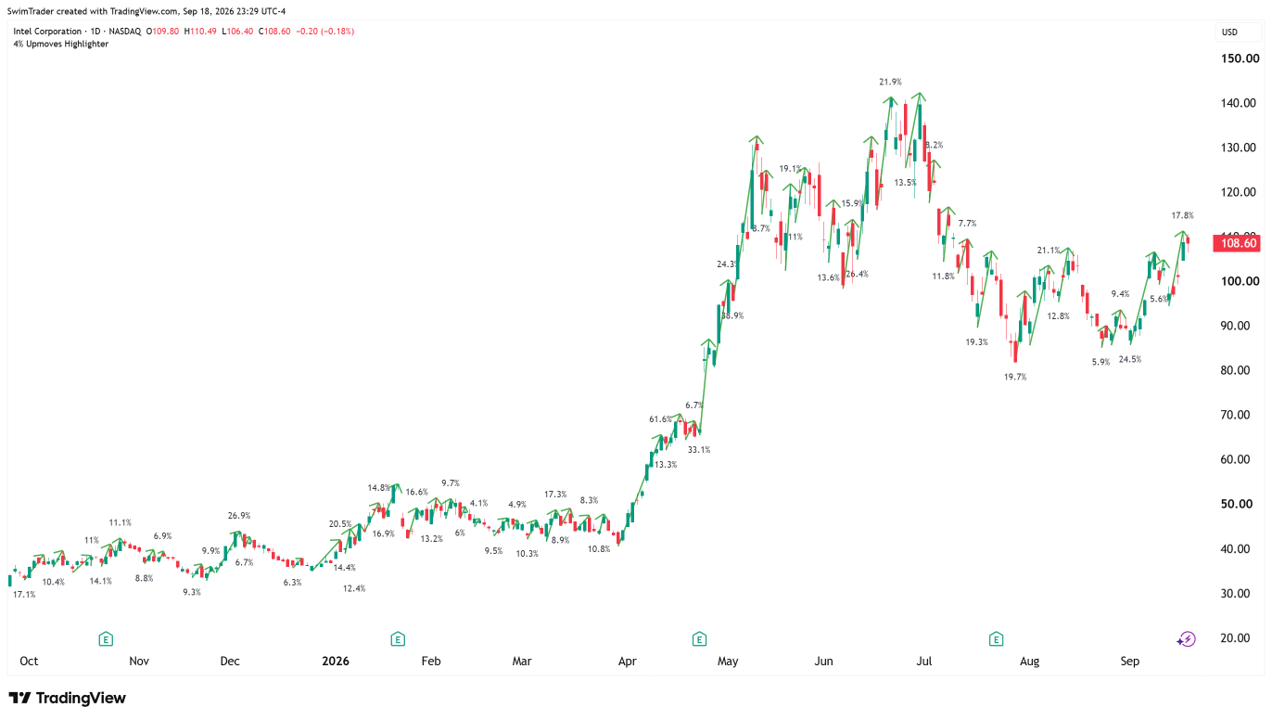
Marking out the explosive upmoves for the past 11 months has left me stunned.
There are 54 explosive upmoves, with each measuring between 4.1% and 61.6%!
You read that right. There’s no typo.
I got more excited when I discovered the size of Intel.
This company enjoys a large market capitalization of nearly $575b! This ranks Intel among the world’s largest technology companies.
Additionally, I appreciate that Intel enjoys an enormous market capitalization, as this provides an extra layer of security against manipulation. I don’t wish to lose my hard-earned money to manipulation that could be easily prevented!
Here comes the golden question: Is it time to buy the shares of Intel for an explosive swing trade?
Key Price Levels
Timing matters in many areas of life. This includes stock trading and investing.
Buying an explosive stock at the wrong time can result in significant losses and emotional distress. This can erode your confidence, and you’ll doubt yourself even when a fantastic trading opportunity comes right under your nose!
Is there a way to tell whether the time to buy the shares of Intel is here?
Fortunately, yes!
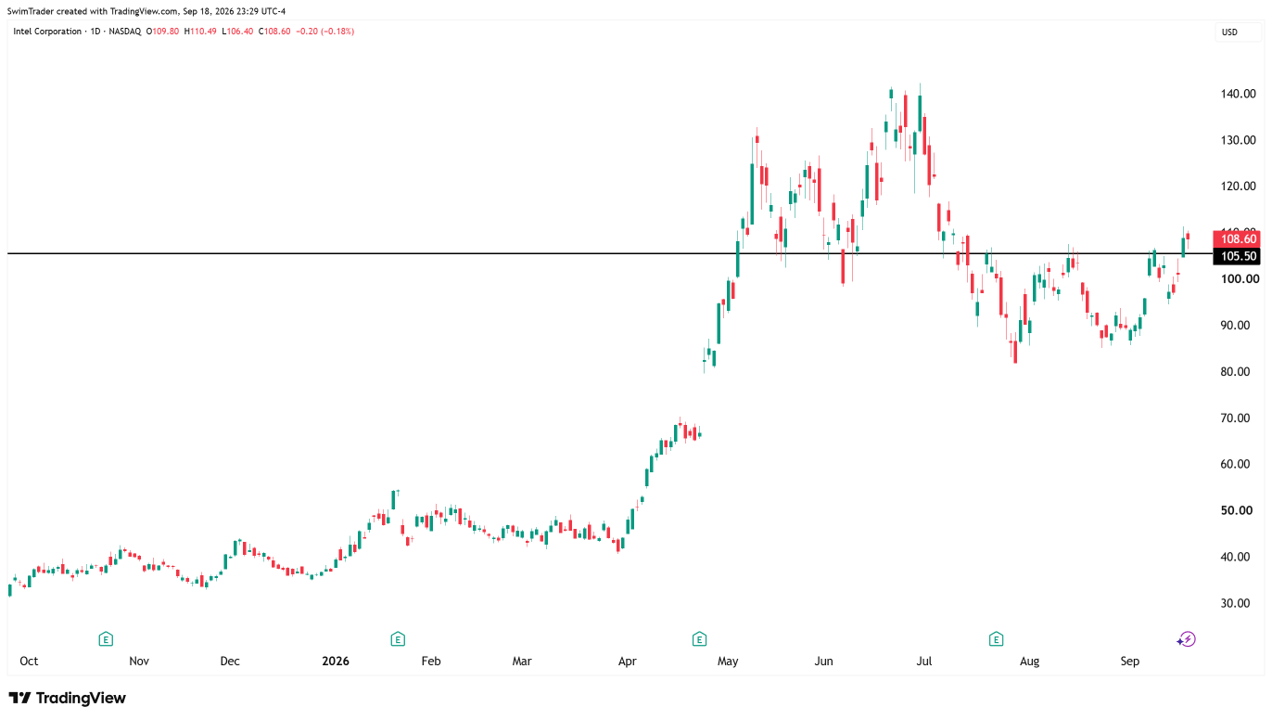
You can do so by uncovering its key price levels (also known as support and resistance zones). And that’s what I’ve done in the chart above.
After rising 17.8% in 1 week, a pullback could come soon. And when the pullback comes, I anticipate its shares to pull back to its support zone of around $105.50 before rising.
Thus, I would like to wait for the scenario above and a bounce off $105.50 before buying its shares to catch its next explosive upmove.
Here’s a pro tip: Instead of staring at your screen, consider setting a price alert on your broker’s platform to be notified so that you can spend precious time with your loved ones.
Which Instrument Should You Consider Using?

Do you ever wonder about the instrument used to trade explosive stocks?
With 3 main trading instruments available – stocks, contract-for-difference (CFD), and options, you wonder which suits you best.
Since stocks (as an instrument) is easy to understand, I shall focus on CFD and options.
Here are the main similarities and differences:

CFD works like a mirror to stocks. When a stock rises $1, its CFD rises $1.
However, due to its unique pricing mechanism, your options price doesn’t rise by the same amount. In fact, depending on the market conditions, the price of your options contract may even drop!
Your CFD broker will charge you a finance fee for lending you money for your trade. However, no lending is required for options, so there is no finance charge.
Because there’s a finance charge by your CFD broker, CFD is not the ideal instrument for mid to long-term trades. On the other hand, options allow you to implement different strategies across time horizons.
Both CFDs and options are leveraged instruments because they allow you to control a larger market position with a smaller amount of capital.
While CFDs do not have an expiration date, options traders must pay attention to the expiration date of their options contracts.
You must be thinking, “What’s the beauty of trading options?”

Options are like smartphones. You can choose to use a smartphone for its basic or advanced functions.
And options don’t have to be all about Math and dry!
It can be made easy to understand through real-life analogies.
In the same way, you can implement basic and/or highly advanced strategies depending on your level of comfort.
Options allow you to be versatile in adapting to the shifting market conditions and capturing opportunities in the process.
Are you a CFD or options trader?
I’m glad to be fluent in both.
Finally, this is for educational purposes. Please perform your due diligence.
All images are taken from pexels.com, pixabay.com, sectorspdrs.com, tradingview.com, and unsplash.com, unless otherwise mentioned.
Want To Learn How I Find Stocks Like Intel?
Intel is just one example.
Opportunities like this appear in the market all the time.
The difficult part isn’t knowing they exist.
It’s knowing how to spot them.
And after spotting them, knowing –
→ When does an entry actually make sense?
→ When is good to exit and take profit…
→ And when should you simply stay away?
Without a system, it’s easy to jump between stock tips, news, indicators, and opinions.
You don’t know what you should look out for…
And every trade feels like a gamble. A risk.
So if you haven’t attended my FREE Online Preview before – join the next one.
Not only will I show you how to find opportunities like Intel…
I’ll also walk you through how I use a repeatable system to know when to enter and exit – instead of relying on random tips or guesses
Click the banner below to reserve your seat for the upcoming free session.