The most anticipated season of the year is finally here!
While children run around playing with foam (aka fake snow) and enjoy their new gifts, adults take a break from work to gather with friends and loved ones.
This is also a time for my team and I to take a break until 2026.
How many gatherings have you attended so far?
As we make merry, is the US stock market sharing the same optimism?
I think so!
Given the market’s volatility lately, I’m not going to enter with all guns blazing. With that said, how did last week’s #PowerStocks pick, Dollar Tree (DLTR), perform?
Review Of Last Week’s Pick Of The Week

Dollar Tree (DLTR) was last week’s #PowerStocks pick.
It’s among the world’s largest retailers, worth over $26b.
As expected, its share price began to pull back after rising more than 20.5% in 2 weeks.
Things are going according to my trading plan: I’m camping at around $120.50 and waiting for a bounce.
Where do I plan to take profit at upon entry?
Head over to my Telegram Channel to find out!
Speaking of Telegram, my team and I will never ask you for your hard-earned money for “investments”.

I know and understand that the allure of high returns without effort is highly attractive. It breaks my heart when I hear of people falling for impersonation scams.
To protect you from scams, please note that my team and I WILL NEVER solicit for any investment.
A list of our official communication channels can be found here.
Why Is Swing Trading Southwest Airlines (LUV) Worth It?

Source: southwest.com
Southwest Airlines is 1 of the world’s leading airlines, focusing on flights across North and South America.
The company enjoys a massive market capitalization of over $21b.
Despite this mammoth market capitalization, its shares are explosive, rising 20 times over the past 11 months, with each move ranging from 4.5% to 39.9%.
After rising 39.9% in under a month, its share price has begun to pull back.
What’s my game plan?
Where’s a favorable price area to buy its shares at?
Continue reading to get the details.
P.S. What if I told you that you could drastically gain control over your emotions of fear and greed, and master the stock market in a short amount of time?
My team and I have worked tirelessly to help you achieve results fast.
Click on the banner below to claim your stock course for free (limited time) now!

Performance Of US Stock Market vs Southwest Airlines (LUV)
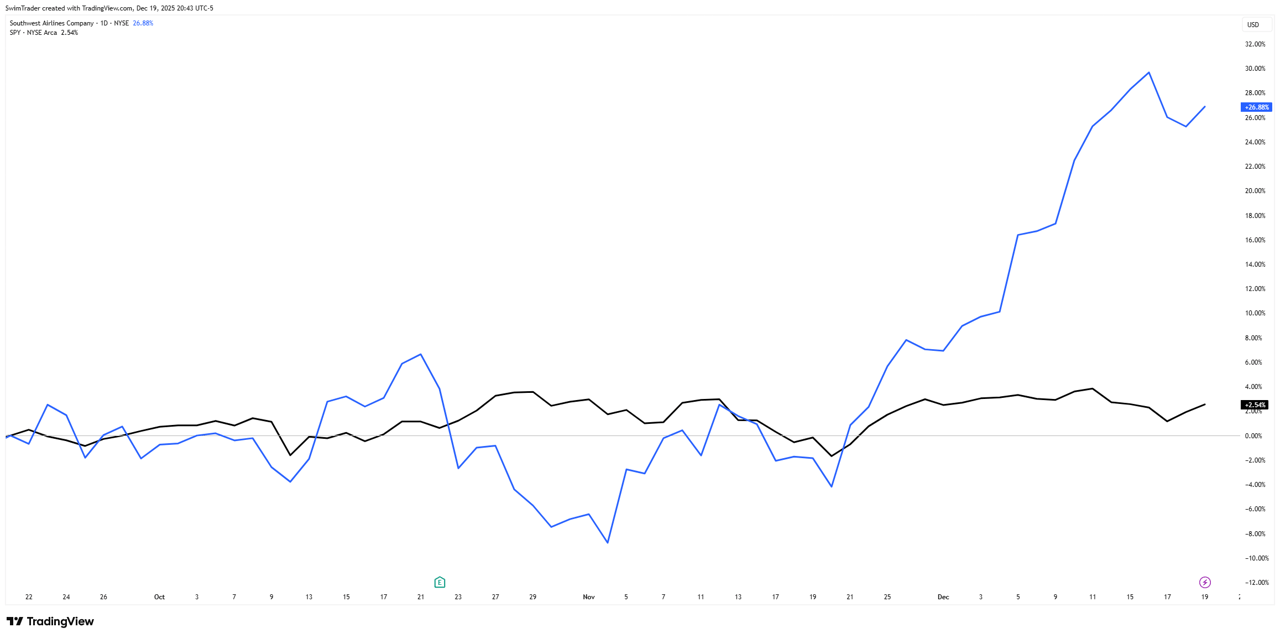
The very 1st thing I want to know is the trend of Southwest Airlines’ shares.
Knowing the trend of its shares allows me to determine whether I’d look for a buying or shorting opportunity because following its price trend will sharply increase my chances of profitability.
Looking at the chart above, its shares are in a steady and strong uptrend. Hence, I’d like to find an opportunity to buy its shares.
What’s next?
I’ll compare the performance of its shares against the S&P 500.
Why?
I want my hard-earned money to work hard for me. A stronger performing stock is likely to continue delivering a larger-than-market return. So, I’ll take another look at the comparison chart above.
While the S&P 500 has risen 2.5% over the past 3 months, the shares of Southwest Airlines have risen by a mind-boggling 26.8%! That’s more than a 10x outperformance!
I’m esctatic. I can’t wait to buy its shares for an explosive swing trade.
Should I do just that now?
How Explosive Is Southwest Airlines (LUV)?
No, I shouldn’t rush to buy its shares without a deeper analysis.
Since I plan to buy its shares and capitalize on its next upmove rather than accompanying it when it pulls back, my holding period will be around a week or 2. Therefore, I want its shares to have the ability to explode upwards.
Have the shares of Southwest Airlines been exploding upwards consistently?
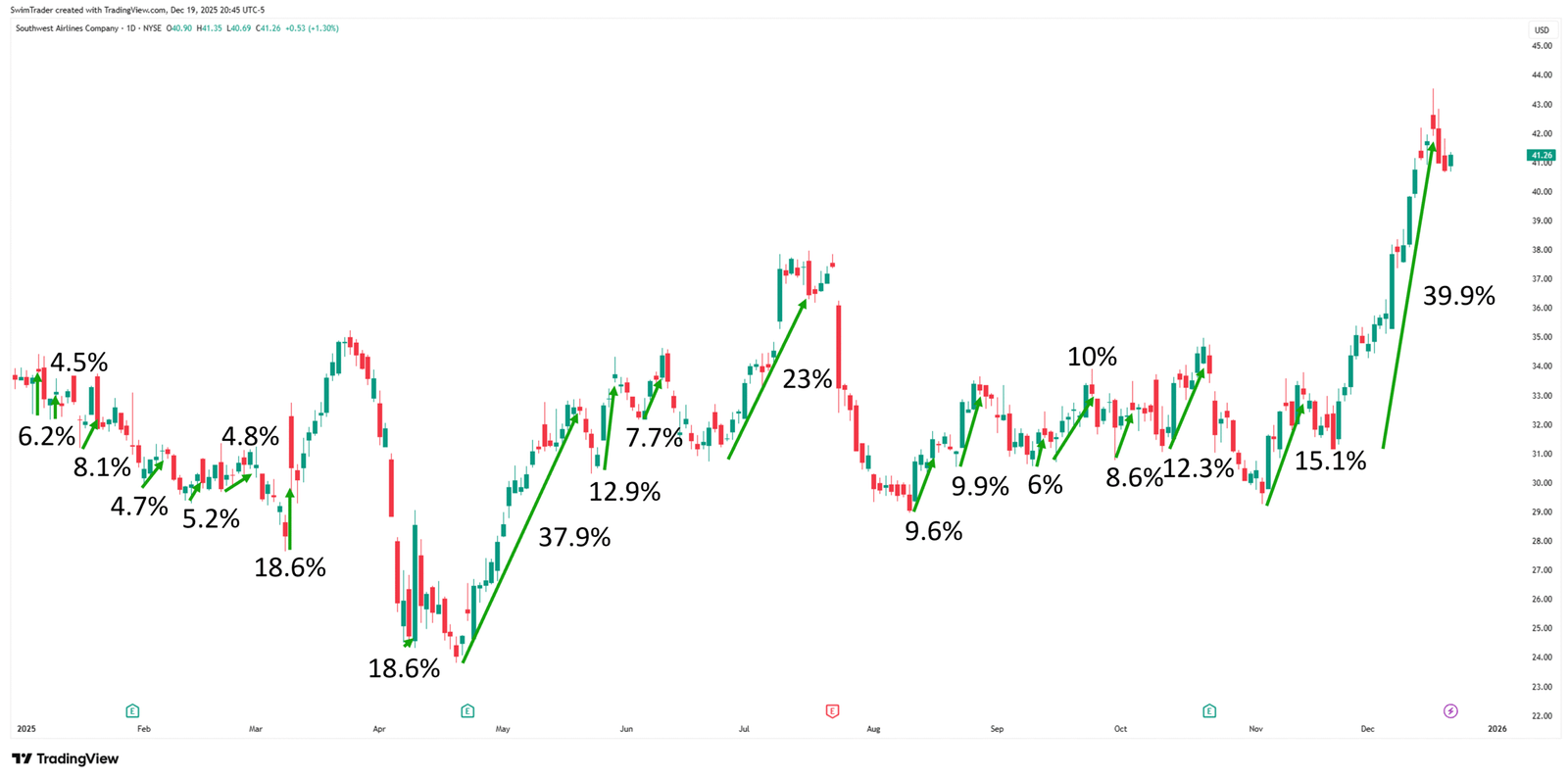
Marking out the explosive upmoves for the past 11 months has left me stunned.
There are 20 explosive upmoves, with each measuring between 4.5% and 39.9%!
I got more excited when I discovered the size of Southwest Airlines.
This company enjoys a huge market capitalization of over $21b! It’s no feat for the shares of such a company to explode in price consistently.
Additionally, I appreciate that Southwest Airlines enjoys a market capitalization of over $21b, as this provides an extra layer of security against manipulation. I don’t wish to lose my hard-earned money to manipulation that could be easily prevented!
Here comes the golden question: Is it time for me to buy the shares of Southwest Airlines for an explosive swing trade?
Key Price Levels

Timing is crucial for many things in life. This includes stock trading and investing.
Buying an explosive stock at the wrong time can result in significant losses and emotional distress. This will cause you to lose confidence, and you’ll doubt yourself even when a fantastic trading opportunity arises straight from under your nose!
Is there a way to tell whether the time to buy the shares of Southwest Airlines is here?
Fortunately, yes!
Here’s how I make an educated guess about where its share price will likely turn at: by identifying its key price levels (also known as support and resistance zones). And that’s what I’ve done in the chart above.
After rising 39.9% in under a month, a pullback has begun.
Where are the shares of Southwest Airlines likely to pull back to?
Referring to the chart above, its shares are likely to fall to around $41 before heading higher once again.
Oh, I like what I see!
I would like to buy its shares for an explosive swing trade now to ride its next huge upmove.
Here’s a pro tip: Instead of staring at your screen, consider setting a price alert on your broker’s platform to be notified so that you can spend precious time with your loved ones.
Which Instrument Should You Consider Using?

Do you ever wonder about the instrument used to trade explosive stocks?
With 3 main trading instruments available – stocks, contract-for-difference (CFD), and options, you wonder which suits you best.
Since stocks (as an instrument) is easy to understand, I shall focus on CFD and options.
Here are the main similarities and differences:

CFD works like a mirror to stocks. When a stock rises $1, its CFD rises $1.
However, due to its unique pricing mechanism, your options price doesn’t rise by the same amount. In fact, depending on the market conditions, the price of your options contract may even drop!
Your CFD broker will charge you a finance fee for lending you money for your trade. However, no lending is required for options, so there is no finance charge.
Because there’s a finance charge by your CFD broker, CFD is not the ideal instrument for mid to long-term trades. On the other hand, options allow you to implement different strategies across time horizons.
Both CFDs and options are leveraged instruments because they allow you to control a larger market position with a smaller amount of capital.
While CFDs do not have an expiration date, options traders must pay attention to the expiration date of their options contracts.
You must be thinking, “What’s the beauty of trading options?”

Options are like smartphones. You can choose to use a smartphone for its basic or advanced functions.
And options don’t have to be all about Math and dry!
It can be made easy to understand through real-life analogies.
In the same way, you can implement basic and/or highly advanced strategies depending on your level of comfort.
Options allow you to be versatile in adapting to the shifting market conditions and capturing opportunities in the process.
Are you a CFD or options trader?
I’m glad to be fluent in both.
Finally, this is for educational purposes. Please perform your due diligence.
All images are taken from pexels.com, pixabay.com, sectorspdrs.com, tradingview.com, and unsplash.com, unless otherwise mentioned.
Claim Your Free (Limited Time) Stock Course Right Now:
The stock market is full of traps laid out by professional traders.
Many new traders are often left confused by conflicting signs and signals.
Worse still, ~80% of traders lose money.
This is because trading isn’t just about skill alone.
It includes the mastery of your emotions.
But what if I told you that you could quickly gain control over your emotions of fear and greed and master the stock market?
My team and I have worked tirelessly to help you achieve results fast.
Click on the banner below to claim your stock course for free (limited time) now!